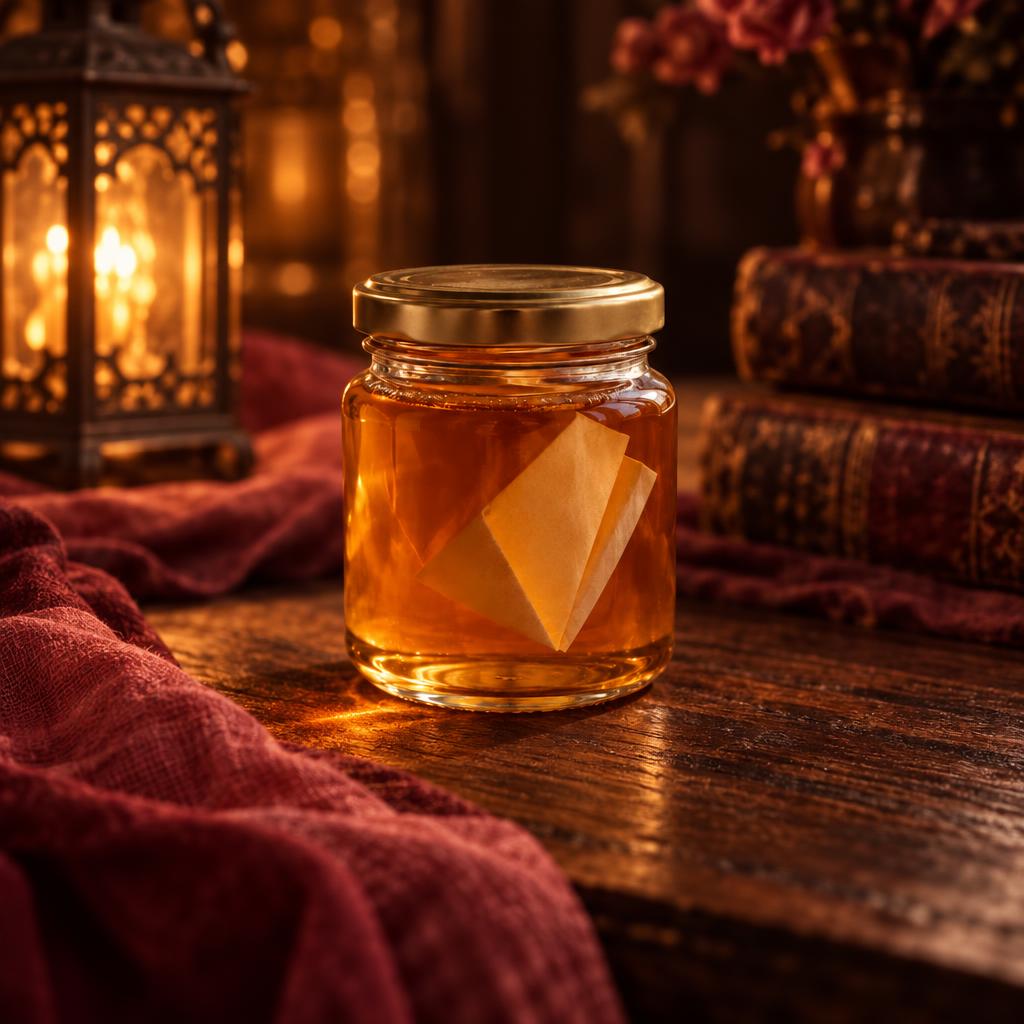
Specific-person love: a sweetening jar
Specific-person love: a sweetening jar
Purpose & expectations
- What is this for?
- An extended symbolic ritual for a welcome, freely chosen connection with someone you have in mind. Not proven to create love or obsession.Reflect on mutually wanted attraction and your own openness to connection.
- What might you experience?
- During a spiritual working you may notice focus, hope, emotion or a clearer intention—or no noticeable change. Experiences are personal; leave room for uncertainty and stop if it feels distressing.
- Timeframe
- Practitioners usually watch for signs during the working and the weeks after: sometimes something shifts within a week, often it takes longer, and sometimes nothing changes. Another person's free will always shapes the outcome, so no exact date can be promised.
- What should you not expect?
- In the tradition, love work is believed to open the way and sweeten feelings. It cannot promise one particular response; the other person's free will still shapes what happens, so treat their real-life answer with respect.
Your ritual, step by step
1 · Gather these supplies
Where does this go?
On your own stable table; close after filling, with no wax seal.
Where does this go?
Fold once towards yourself and place inside the jar; never beneath the candle holder.
Where does this go?
Inside the jar, over the folded paper. This honey is not for eating.
Where does this go?
Inside the jar, on the honey; nothing on the candle.
Where does this go?
Separate stable heat-resistant surface at least 30 cm from the jar, paper and herbs, or farther per label.
2 · Before starting
Tea light · Plain pink tealight
Put the plain candle in a heat-resistant holder, at least 30 cm from paper, herbs, oil and jars (or farther as the label directs). Nothing on the candle or wick; never on a jar lid. Light only once everything is safely placed and you can stay present.
Burn time: optionally 5–10 minutes of attention, not a required burn duration. Follow label limits; extinguish before leaving or sleeping. Never force a complete burn.
- Symbolic practice, not control over anyone’s feelings or choices. More ingredients or repetition do not demonstrate stronger effects. Never ingest ritual contents, secretly administer them or apply them to skin. Avoid allergens; keep children and pets away. Stay present with flame and extinguish before leaving or sleeping.
A question about this step?
Ask about this spell's ingredients or preparation. Answers use only this page's details and sources.
AI answer, may contain mistakes. Tradition, not proven effect.
Protection before, during and after
🛡️ Protection before & after
In herbal craft you always protect yourself around a ritual. Do these steps every time.
Before you start
- ◆Wash your hands and tidy the space – a clean space is a protected space.
- ◆Sprinkle a pinch of salt in the corners of the room or make a salt circle around your workspace.
- ◆Light a white candle and say: 'Only good may enter here. I am protected.'
- ◆Take 3 slow breaths and picture a bubble of white light around you.
While you work
- ◆Keep the white candle burning while you work.
- ◆If you feel uneasy, stop, breathe and touch the salt – then continue or close the ritual.
- ◆Work with a calm, clear intention; never work angry or afraid.
Afterwards
- ◆Thank the herbs and the space, and blow out the candles (never leave them burning).
- ◆Sweep or vacuum the salt and throw it away outside your home.
- ◆Wash your hands up to the elbows to 'close' the work.
- ◆Eat or drink something (tea, bread) to ground yourself.
Timing and calendar
Any day · Any phase; no proven timing advantage
Traditional preferences, not a proven advantage. Do not delay necessary help.
Background, herbs and sources
App-created contemporary adaptation inspired by documented Hoodoo sweetening traditions. The source describes names and sweeteners, but does not verify this exact rose recipe, amounts, one-fold direction or wording. Hoodoo is African American folk practice, not Haitian Vodou or a generic Romani tradition. No lwa or other spirits are invoked. ‘Powerful’ is not a verified effect; practitioner claims are not scientific evidence.

Sources
🌍 Roots & respect
Much herb and candle work (Hoodoo, conjure) comes from African and African American traditions. Haitian Vodou is its own religion: the lwa (spirits) are served within a community led by an initiated houngan or mambo. This site does not call any spirits – every ritual works only with herbs, salt, candles, prayer and your own intention. If you want to learn Vodou itself, look for a real, initiated teacher.
Trusted books (anthropologists and practitioners):
The publisher pages and book contents below were checked; not every full book was read. These document traditions, not proof of forced love or obsession. Mama Lola portrays a Haitian mambo; the Michel and Bellegarde-Smith collection includes Haitian authors. Their work is not a recipe source for our honey jars. Romani traditions are diverse: we do not invent generic ‘gypsy magic’ or rank cultures by power. Look for transparent training, consent and fees in a teacher; guaranteed love or paid emergency curse-removal claims are warning signs.
- Patrick Bellegarde-Smith & Claudine Michel (eds.) — Haitian Vodou: Spirit, Myth, and Reality (2006); Haitian contributors
- Karen McCarthy Brown — Mama Lola: A Vodou Priestess in Brooklyn (3rd ed., 2011), foreword by Claudine Michel
- Claudine Michel & Patrick Bellegarde-Smith — Vodou in Haitian Life and Culture: Invisible Powers (2006)
- Catherine Yronwode — Honey and Sugar Jar history (practitioner account; not evidence of results)
- Deacon Millett — Hoodoo Honey and Sugar Spells (book catalogue and contents; full text not reviewed)
- Zora Neale Hurston – Tell My Horse: Voodoo and Life in Haiti and Jamaica (1938)
- Maya Deren – Divine Horsemen: The Living Gods of Haiti (1953)
- Karen McCarthy Brown – Mama Lola: A Vodou Priestess in Brooklyn (University of California Press, 1991)
- Yvonne P. Chireau – Black Magic: Religion and the African American Conjuring Tradition (UC Press, 2003)
- Katrina Hazzard-Donald – Mojo Workin': The Old African American Hoodoo System (University of Illinois Press, 2013)
- Wikipedia – Haitian Vodou (overview with academic references)
- Wikipedia – Hoodoo (African American folk practice)